


I am the Door
John 10:1-10
1. A Figure of Speech (verses 1-6)
2. A Shepherd to Follow (verses 7-10)
One of the great pictures that the Bible uses to describe God’s care for us is the role of a shepherd.
Now, in our culture, we don’t know much about shepherding. We are not an agrarian culture. So we don’t know all of the details and all of the subtleties of what it means to shepherd sheep. Yet, I think that we know enough to have an idea of what it means to be a shepherd of sheep, because shepherding is a bit like parenting, in that we parents provide for our children. We protect our children from harm. We meet all of the basic needs of our children. We teach our children. We guide them in life. At times we discipline them. At times we comfort them. When they are hurt, we care for their wounds. We are a source of security for them. We sacrifice greatly for them.
All of these sorts of things are true of shepherds, shepherds are like parents of sheep, providing and caring for them in every way. Now, sheep are different than children. The role of a shepherd is different than being a parent.
I don’t know any of this first hand, but I have read about sheep. I have read about how needy they are, needing constant care and guidance. I have read about how helpless they are, having little means to defend themselves. I have read about how timid they are, being easily frightened. I have read about how they are easily stressed, needing then, the constant security that a shepherd can provide. I have read about how they are easily led astray, needing the constant guidance of a shepherd, thus, making sheep the perfect picture of what it means to be human.
So, a a verse like Isaiah 53:6 makes perfect sense: "All we like sheep have gone astray; we have turned—every one—to his own way; and the LORD has laid on him the iniquity of us all." We are like sheep, going astray to our own ways. And apart from Jesus taking our sin upon his shoulders, we would have perished.
The Bible uses this shepherding imagery quite a bit to describe God’s care for us. Perhaps the most famous Bible verse that speaks about this is Psalm 23. It begins with these famous words, “The LORD is my shepherd; I shall not want” (Psalm 23). God is the one who cares for us, so that we lack nothing of our needs.
The entire Psalm is filled with imagery about how God cares for his people like a shepherd cares for his flock. Just like a shepherd leads his sheep to green pastures and to still waters (Psalm 23:1), so God will lead his people in paths of righteousness, restoring our souls (Psalm 23:1). Just like a shepherd is needed in times of fear, so God will be with us, comforting us and guiding us (Psalm 23:4). Just like a shepherd protect from danger, so God will “prepare a table before us in the presence of our enemies” (Psalm 23:5). Just like a shepherd is good to his sheep, so will God’s goodness and mercy follow us all the days of our lives.
But Psalm 23 isn’t the only passage in the Bible that speaks of God being our shepherd. The Psalms mention it often. In Psalm 78:72, the history of God’s care with Israel is summarized as God shepherding his people. In Psalm 95:7, we read that “He is our God, and we are the people of his pasture, and the sheep of his hand.”
The prophets were fond of this imagery as well. Isaiah 40:11 is one of the great promises of the Bible. “He will tend his flock like a shepherd; he will gather the lambs in his arms; he will carry them in his bosom, and gently lead those that are with young.”
What a wonderful thought! That God cares for us like a shepherd. It ought to comfort your heart to know that as you walk through this life, your heavenly Father from above is watching over you will a heart to care for you.
But not only does the Bible describe God as a shepherd, but spiritual leaders are also described as being shepherds of God’s people, who are given the task of watching over and caring for God’s people.
The word, “pastor” comes from the word for “shepherd.” This is my duty and the duty of the elders, to care for those of this church, as a shepherd cares for his sheep. Paul said to the Ephesian elders, "Pay careful attention to yourselves and to all the flock, in which the Holy Spirit has made you overseers, to care for the church of God, which he obtained with his own blood. Literally, “to shepherd the church of God” (Acts 20:28).
The idea of “shepherding” is the primary metaphor given to spiritual leaders of God’s people. We see it often in the Old Testament, and usually, we see it in the shepherds failing in their duties. "For the shepherds are stupid and do not inquire of the LORD; therefore they have not prospered, and all their flock is scattered" (Jeremiah 10:21).
Perhaps the most famous of condemnations is found in Ezekiel 34. The entire chapter is devoted to condemning the spiritual leaders of Israel. “Son of man, prophesy against the shepherds of Israel; prophesy, and say to them, even to the shepherds, Thus says the Lord GOD: Ah, shepherds of Israel who have been feeding yourselves! Should not shepherds feed the sheep?” (Ezekiel 34:2).
The point is clear: There are good shepherds. There are bad shepherds. Oh, may God give grace to the shepherds of Rock Valley Bible Church to be good shepherds.
Now, all of that background of God being our shepherd, and of spiritual leaders given the task of shepherding the church, comes out in John, chapter 10, which is where we have come in our exposition of the gospel of John. For each chapter in the gospel of John, we have had a picture. For this chapter, we have a picture of a gate. The number 10 can look like a gate with the "0" being the door and the "1" being the hinge upon which the door swings.
This is a perfect illustration for chapter 10 and for my message this morning, which I have entitled, “I am the Door.” This is what Jesus says in verse 7, “Truly, truly, I say to you, I am the door of the sheep.” The NIV translates this, “I am the gate.” The idea is the same, Jesus calls himself the door, or the gate to the sheepfold.
This, by the way is the third, “I am statement in the gospel of John.” First off, in John chapter 6, we heard Jesus say, “I am the bread of life.” This came in connection with Jesus feeding the 5,000. Saying that he is the one who can provide all our needs and sustain us in life.
Second, in John chapter 8, we heard Jesus say, “I am the light of the world. Jesus said this in connection with the Feast of Booths, when the Jews celebrated with large lamps that were lit. Jesus illustrated this in John, chapter 9 with the healing of the blind man. all of this says that Jesus is the one who can guide us lead us to life.
And now, in chapter 10, Jesus will say, “I am the door of the sheep.” As we shall see, this signifies that Jesus is the one through whom we find life. Consider the first half of our passage:
John 10:1-6
“Truly, truly, I say to you, he who does not enter the sheepfold by the door but climbs in by another way, that man is a thief and a robber. But he who enters by the door is the shepherd of the sheep. To him the gatekeeper opens. The sheep hear his voice, and he calls his own sheep by name and leads them out. When he has brought out all his own, he goes before them, and the sheep follow him, for they know his voice. A stranger they will not follow, but they will flee from him, for they do not know the voice of strangers.” This figure of speech Jesus used with them, but they did not understand what he was saying to them.
My first point is
1. A Figure of Speech (verses 1-6)
That’s what we see in verses 1-6. This is what John calls it in verse 6, “This figure of speech Jesus used with them.”
The elements of this figure are pretty simple. You have a “sheepfold.” That is, an enclosure where the shepherd keep their sheep at night. In Bible times, they didn’t have a chain-link fence or barbed wire, to keep the sheep in the sheepfold. Some sheepfolds were surely made of wooden fences, but most of them were built of stone walls the walls were just high enough to keep the sheep in, and to keep the wolves out. Here is a helpful picture:
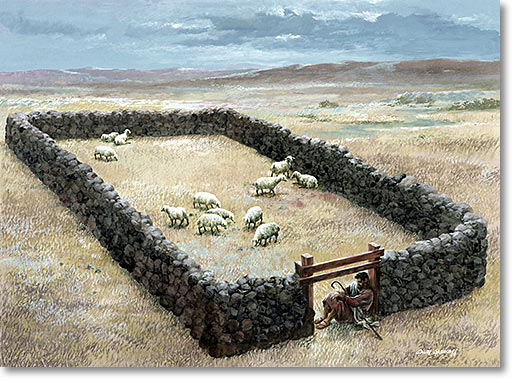
The most significant aspect of the sheepfolds, however, is that there was only one door. It’s the door by which the sheep enter. It’s the door by which the sheep exit. Having only one door means that the shepherd easily guards the sheep, by placing himself in the doorway.
Now, in verse 3, we are introduced to the gatekeeper. He is the one who opens the door for the shepherd. In the ancient world, the gatekeeper watched over the sheepfold, usually keeping the sheep for the night. Come dusk, the shepherds would bring their sheep into the sheepfold. and entrust them for safekeeping to the gatekeeper for the evening, so that the shepherd could go and get some sleep.
Often, there would be several shepherds who would keep their sheep in the same sheepfold, all of them entrusting their sheep to the care of the same gatekeeper, who would stay up all night, watching the sheep. Since there is only one door, the gatekeeper simply needs to watch over the single door. Come morning, these shepherds, they would then retrieve their sheep.
This is not unlike our nursery here at church. Parents, you show up early with your small children, and you check them in with the nursery workers, who keep them safe during the service. And then, after the service, you go and retrieve your children, by using the “KidCheck” app. Now, I’m not sure how all of this goes, but somehow, you match the sticker on the back of your child with the identification in your app. and when those match, you take your child an go on your way, until next week.
Now, in Bible times, they didn’t have “KidCheck” to retrieve their sheep from the sheepfold. But, the way that the shepherds retrieved their sheep was easy: a shepherd would simply call for his sheep. His sheep knew his voice and they would come, and follow him to the pasture for the day. Then, at night, they would return again to the sheepfold to entrust their sheep to the gatekeeper until the morning.
This is how it often worked in Bible times. Now, I have never seen this, as I said in my introduction, I don’t have firsthand experience of shepherding, that the sheep are especially tuned into the voice of their shepherd. This is what Jesus says in verse 4, “They know is voice.”
In preparing for my message this morning, I heard several pastors preaching on these verses refer to an experiment that was once done. I couldn’t find it, so I’m not sure that it’s really true. But from all that I know about sheep, I have no doubt that such would be true if tried. It illustrates the point well.
The experiment went this way: A shepherd was watching over his sheep, prepared to call his sheep, so that they could follow him to the pasture. But before he did so, he took off his shepherding clothes and gave them to another man, who tried to, “stand in” for the shepherd. This man, dressed in the clothes of a shepherd, tried to call the shepherd’s sheep to follow him. But when they heard the strange call of the man who looked like their shepherd, rather than coming, they ran away scared. Because, sheep don’t respond to what the shepherd looks like. Sheep respond to what the shepherd sounds like.
John 10:4-5
They know his voice. A stranger they will not follow, but they will flee from him, for they do not know the voice of strangers.
Not growing up on a farm, and having no experience with sheep, I have never seen this, but I would suspect that it is true.
Now, what I have seen is the way that I can call my children. When my children were small, I trained them on my whistle. I remember being at a large park one time with my two oldest children, when they were maybe 5 and 6 years-old. I told them to start running, at some point, I would whistle. When they heard my whistle, I instructed them to stop and locate me. Then, with my hands, I would motion to them what I wanted them to do, whether I wanted for them to come back or keep going. So, they began running, and running, and running. When they were a ways off, 50 yards away? I whistled. They stopped and they located me. I with my hands, I motioned that they should keep going. I did the same when they were 100 yards out. I whistled. They located me. I motioned to keep going. When they got to be about 200 yards out, I whistled. They located me. I motioned for them to come to me. and they returned.
From that day, my children knew my whistle. To this day, if I can see my children, however far off they are in the park, however loud it is in the gymnasium, I can whistle and they will stop what they are doing and look for me and see what I want.
There have been times when my children were all spread out at a park playing, but I wanted only one of them to come. I whistled, and they all stopped what they were doing, and looked at me. I waved off some of my children, but I signaled to the one that I wanted to come to come. and he (or she) came.
I share this because I think it’s a bit like the voice of a shepherd. The sheep will hear his voice and follow him. They will run from the stranger.
So, when I’m in a crowd with lots of people, and I whistle. Lots of people turn to look, asking themselves, “Who whistled?” But they look around, and quickly go on their way. But not my children. My children will find me and will look to see what I want from them, just like the voice of the shepherd.
OK, regarding this “figure of speech,” we have seen the sheepfold. We have seen the gatekeeper. We have seen the voice. But we haven’t considered the thief and the robber.
John 10:1
Truly, truly, I say to you, he who does not enter the sheepfold by the door but climbs in by another way, that man is a thief and a robber.
In a sheepfold, it is obvious who the shepherd is and who the thief or robber is. The shepherd comes to the door and calls the sheep. They hear his voice and come. The thief will not come by the door, but will jump the fence, trying to overcome the sheep, perhaps take them out by another way, rather than the door. These are the ones who can’t persuade the sheep come willingly, by following his voice. Instead, they come and seek to snatch the sheep by force.
Now, we have the “Figure of Speech” in our minds. Let’s read it again.
John 10:1-6
Truly, truly, I say to you, he who does not enter the sheepfold by the door but climbs in by another way, that man is a thief and a robber. But he who enters by the door is the shepherd of the sheep. To him the gatekeeper opens. The sheep hear his voice, and he calls his own sheep by name and leads them out. When he has brought out all his own, he goes before them, and the sheep follow him, for they know his voice. A stranger they will not follow, but they will flee from him, for they do not know the voice of strangers.” This figure of speech Jesus used with them, but they did not understand what he was saying to them.
It seems as if this figure of speech is clear enough, but “they didn’t understand.”
The key to understanding this is to understand chapter 9, which we looked at last week. What happened in that chapter? Jesus healed a blind man, by spitting on the ground and making mud, and by applying this to the man’s eyes, and telling him to wash.
This healing stirred the hostility of Jewish leaders against Jesus. They tracked down the man who was born blind, and tried to intimidate him to denounce Jesus. They talked with their parents, who were fearful of being cast out of the synagogue.
In other words, these spiritual leaders were the thieves and robbers. They were bullies. They bullied the man born blind, eventually casting him out (John 9:34). They bullied his parents, with the threat of casting them out of the synagogue (John 9:22).
These were the shepherds of Israel! Given to love and care for the people of God. Rather than carrying for the people, they bullied them.
What was true back then is certainly true today. There are many pastors today who are really bullies. They intimidate people. They threaten. They coerce. They manipulate. If you see such a pastor, run from such a pastor, like the sheep do in verse 5, “they flee from him.”
The character of these Pharisees was clear. Back in chapter 8, when Jesus was speaking with them, they didn’t hear his voice. Instead, they argued and resisted at every turn.
In this figure of speech, Jesus was telling them, “You don’t hear the voice of the true shepherd.” You resist him at every turn.
Instead, the sheep are the ones who hear the shepherd and follow after him. Look at verse 3 again,
John 10:3-4
... The sheep hear his voice, and he calls his own sheep by name and leads them out. When he has brought out all his own, he goes before them, and the sheep follow him, for they know his voice.
Notice the character and demeanor of the shepherd. He speaks and the sheep follow him. He doesn’t drive them from behind, rather, he leads them from the front.
Such is the character of a good pastor. He will lead from the front. The people will hear his voice and follow him. He will not drive them from behind. He will never ask them to do what he is not doing or willing to do. He won’t intimidate. Rather, he will call and people will follow.
This leads nicely into my second point this morning. Jesus gave
2. A Shepherd to Follow (verses 7-10)
John 10:7-10
So Jesus again said to them, “Truly, truly, I say to you, I am the door of the sheep. All who came before me are thieves and robbers, but the sheep did not listen to them. I am the door. If anyone enters by me, he will be saved and will go in and out and find pasture. The thief comes only to steal and kill and destroy. I came that they may have life and have it abundantly.
Here’s where we get the title of my message this morning: “I am the door.” Jesus says it twice, in verse 7 and in verse 9.
Again, I think that our picture of the sheepfold will help us here. Again, I remind you that there is one door into this fenced-in area. The shepherd sits across the threshold of the entrance to the sheepfold.
In this way, he essentially becomes the door. No sheep will come into the sheepfold, unless it passes by the shepherd. No sheep will come out of the sheepfold, unless it passes by the shepherd.
When the Jews rejected Jesus, like in chapters 8 and 9, they demonstrated themselves to be “thieves and robbers,” who sought access to God in some other way, other than the door to the sheepfold.
In verse 9, Jesus gives the promise of the text:
John 10:9
I am the door. If anyone enters by me, he will be saved and will go in and out and find pasture.
This is the point of the gospel of John, salvation comes through Jesus. It is through him that you enter into the sheepfold. It is through him that you leave the sheepfold to find your pasture.
In fact, it is only through Jesus that you can enter the sheepfold. In John 14:6, Jesus says, “I am the way, and the truth, and the life. No one comes to the Father except through me.”
The only way to come to the Father is through Jesus. You can’t get to the Father through Abraham, Isaac or Jacob. You can’t get to the Father through Moses or any of the Prophets. You can’t get to the Father through Peter or Paul or the apostles. You can’t get to the Father through the saints who have walked with God through the ages. You can’t get to the Father through your good deeds. You can’t get to the Father through your philosophy or intelligence.
There is only one way to the Father: through Jesus. That’s the point of him calling himself, “the door.” Entrance to the kingdom of God comes through him! This is in contrast to the thief who jumps the fence to get to Jesus.
John 10:10
The thief comes only to steal and kill and destroy. I came that they may have life and have it abundantly.
In the context here, the thieves are the Jewish leaders. They are like the false shepherds of Ezekiel 34. Listen to their condemnation:
Ezekiel 34:3-4
You eat the fat, you clothe yourselves with the wool, you slaughter the fat ones, but you do not feed the sheep. The weak you have not strengthened, the sick you have not healed, the injured you have not bound up, the strayed you have not brought back, the lost you have not sought, and with force and harshness you have ruled them.
This describes the Pharisees exactly, who ruled their people with an iron fist. who threatened people with being put out of the synagogue if they would confess Jesus to be the Christ. They didn’t bring joy. They didn’t bring happiness. They didn’t bring life.
On the contrast, Jesus does.
John 10:10
The thief comes only to steal and kill and destroy. I came that they may have life and have it abundantly.
Now, there are some who will preach that if you believe in Jesus, then your life will be better! you will be blessed beyond all measure! Of course, this is true, because this is what this verse is saying! Jesus came to give us abundant life! There's happiness and joy and peace in this world, and there is everlasting life in the world to come!
The problem with the health, wealth, and prosperity preachers is that they don’t preach the other side. They will preach John 10:10. But they won’t preach John 15:19, where Jesus says to his disciples, "If you were of the world, the world would love you as its own; but because you are not of the world, but I chose you out of the world, therefore the world hates you."
But we, on the other hand, may be so aware of the hardships that Christians face in this world, that we only preach the cost of following Jesus, which is true. But John 10:10 is also true!
Jesus has come to give us life! Jesus has come to give us abundant life! He has come to give us joy and hope. more than the world has. David said it this way, "You have put more joy in my heart than they have when their grain and wine abound" (Psalm 4:7). Even when it goes really good for them, the joy that you have given me is more than what they have.
It might not be that we are wealthy or healthy, but there is the joy that God gives. We can only have this through Jesus.
How does this joy come? Only through Jesus. It doesn't come through the false shepherds. It only comes through the true shepherd.
How did Jesus accomplish this? It comes in our text next week, "I am the good shepherd. The good shepherd lays down his life for the sheep" (John 10:11). This is what Jesus does as the door. He is laying down over the threshold of the sheepfold, laying down his life for the sheep.
Regarding corporate structures, it is often shaped as a pyramid, with the CEO at the top. But Jesus, as he laid down his life for us, he is at the bottom of the church organizational chart, as he serves everyone on the top. Likewise, his undershepherds should be on the bottom of the church organizational chart, as they seek to serve the sheep.
Jesus laid down his life for the sheep. His humility was greater than anybody as Philippians 2:6-8 describes.
Philippians 2:6-8
[Jesus] though he was in the form of God, did not count equality with God a thing to be grasped, but emptied himself, by taking the form of a servant, being born in the likeness of men. And being found in human form, he humbled himself by becoming obedient to the point of death, even death on a cross.
And since Jesus went lowest of low and purist of pure, and since Jesus suffered unjustly, therefore, God has highly exalted him in heaven, sitting at the right hand of God (Philippians 2:9-11). But the exaltation and glory comes to Jesus because he was low. This has his path, as he laid down his life for us.
This sermon was delivered to Rock Valley Bible Church on March 16, 2025 by Steve Brandon.
For more information see www.rockvalleybiblechurch.org.